You've watched this reset happen before.

A new property comes with its own people, firms and systems. So does a vessel. So does an aircraft.

Anchor Estate
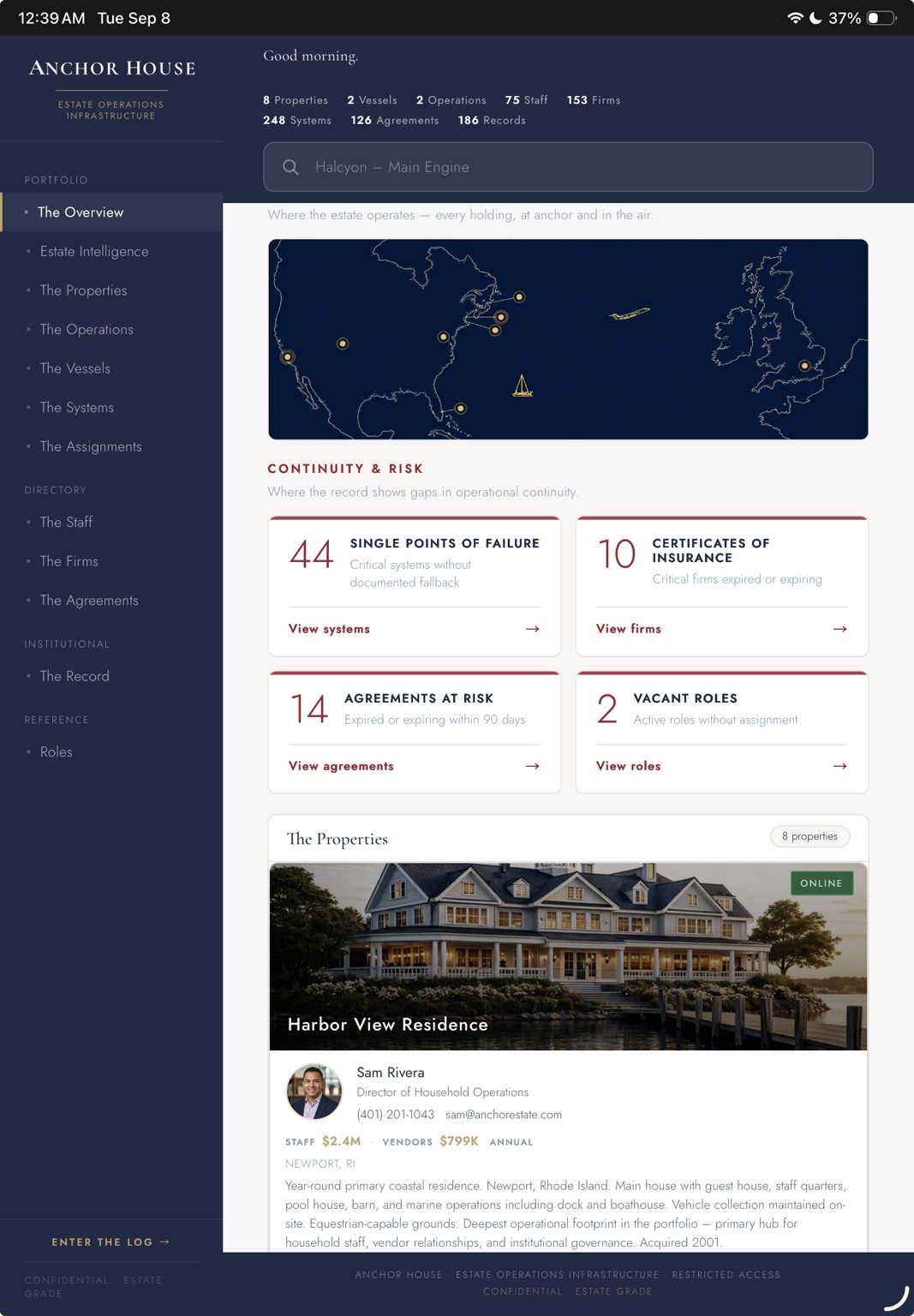
8 properties · 2 vessels · 2 operations

The demonstration estate, held in one record.
Enter The Record →

Every family office has institutionalized the financial picture. None have institutionalized the operational one.

The View From Above

The operating estate, in view.

The family's properties, vessels and specialized operations have their own staff, firms, agreements and systems. The family office is responsible for the broader picture, but much of the underlying information remains with the people operating each holding.

The invoices reach the family office. Most of the operating structure behind them does not.

Anchor House connects each holding to the people, firms, agreements and records behind it.

Operational Footprint by Holding
Agreements and estimated role cost, per holding, per year
$14,480,000 annually
Role costAgreements
Properties
  • Harbor View$4.37M
  • Chelsea$2.93M
  • Mountain View$894K
  • Vineyard$781K
  • Cliff Walk$667K
  • Sand Palace$662K
  • Miramar$500K
  • Primrose Hill$431K
Operations
  • Equestrian$576K
  • Vineyard$216K
Vessels
  • Meridian$2.68M
  • Halcyon$565K
Role cost $9,301,000Agreements $5,179,000Total $14,480,000
Operations are shown within their parent holding and are not added again to the estate total. Role costs are approximate annual figures for active assignments and are not connected to payroll systems.
Across the Estate
Properties
Each residence remains connected to the staff, firms, systems and agreements involved in operating it.
Vessels
Captains remain responsible for their vessels, while the systems, agreements, decisions and operating history remain connected to the estate record.
Aviation
Flight departments, fractional ownership and charter arrangements retain their own providers, standards and operating structures. Their agreements, contacts and decisions remain connected to the estate record.
Operations
Specialized operations – vineyard, equestrian and others – retain their own leadership and working methods while remaining legible within the wider estate.
Collections
Art, wine and other collections retain their own conservators, specialists and agreements. The people, firms and decisions behind them remain part of the estate record.
Estate
The family office can understand how the holdings relate without taking over the work of the people responsible for them.

Anchor House displaces nothing – not the management platforms, not the operators’ tools, not the way each holding is run. It holds the record around that work, so the record stays with the estate when the people do not.

Scope

What Anchor House holds, and what it doesn't.

Anchor House exists outside staffing changes, management transitions, and internal politics. It holds the record regardless of who is running the estate – and is accountable to that record alone.

Anchor House holds
  • The permanent operational record of the estate
  • Every operator, firm, system, agreement, and staff role – across properties, vessels, aircraft, agricultural operations, collections, and other holdings – linked and searchable
  • The governance layer that defines who owns what decision
  • The institutional memory that survives every transition
  • Ongoing stewardship – not a one-time engagement
Anchor House does not
  • Manage day-to-day estate operations or staffing
  • Displace any existing systems or processes
  • Write operating procedures or manuals
  • Facilitate scheduling, task management, or logistics
  • Hold financial data, payroll, access credentials, or legal structures
  • Offer document storage of any kind
How it works alongside you

Anchor House builds and maintains the record without changing the people or systems already in place. You run the estate. When someone moves on, what they built stays with the estate, and so does the reasoning behind it.

The Structural Gap

It has always lived with someone.

Good operators build it anyway, by hand, each time. Then it goes with them.

Operators carry the institutional record themselves – because nothing has ever existed to hold it at the estate level. The structure underneath it has never been built.

Anchor House is that structure. The record sits with the estate. Operators do their work alongside it, not in place of it.

What the Record Preserves

There should already be a record of this.

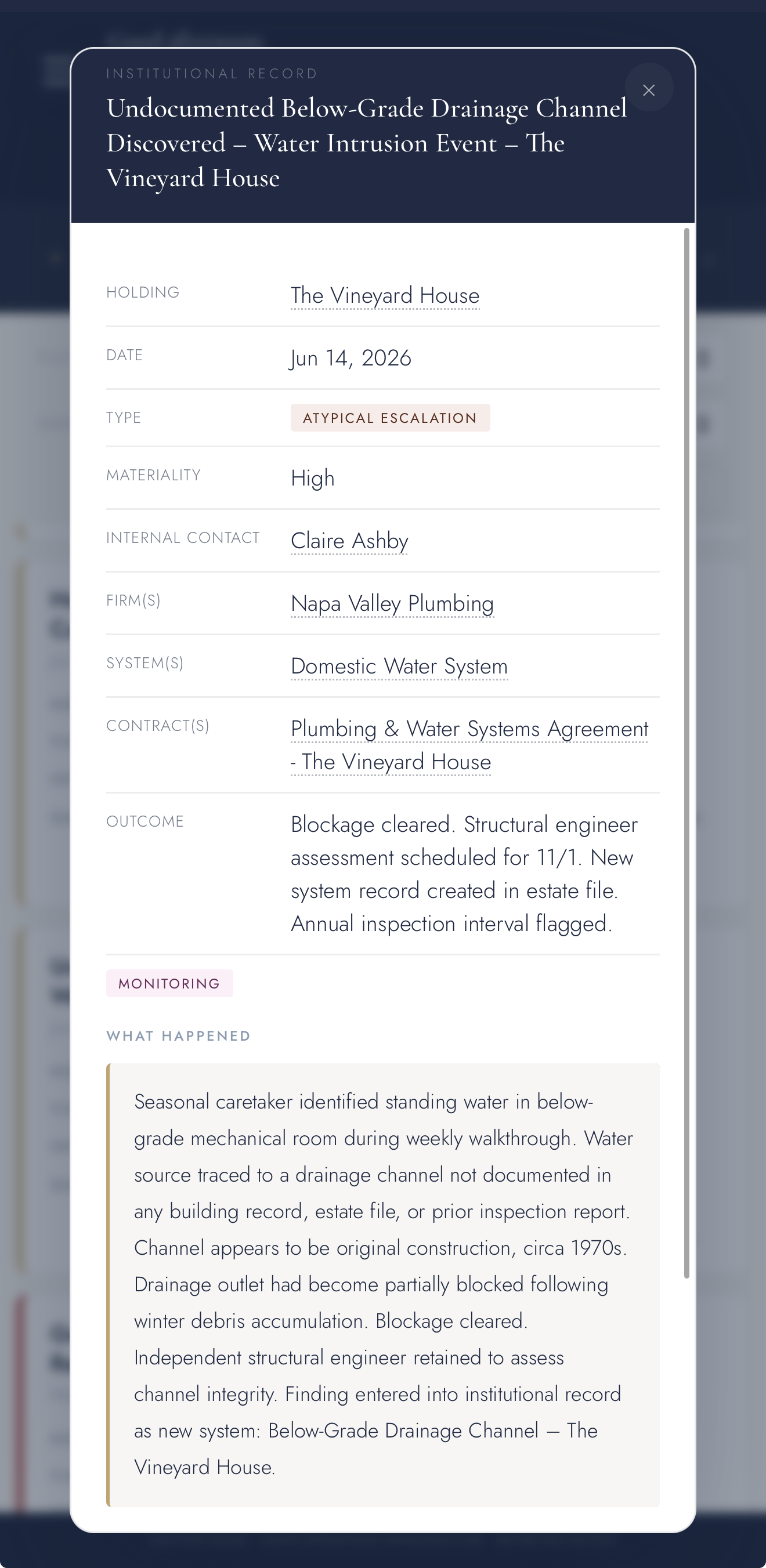
At The Vineyard House, a water-intrusion event revealed a drainage channel that appeared nowhere in the property's existing documentation.

The finding was entered into the institutional record with the people involved, the relevant system and agreement, the work performed and an inspection requirement.
From the Institutional Record
Undocumented Below-Grade Drainage Channel Discovered
The Vineyard House · June 14, 2026
The complete Institutional Record for the undocumented below-grade drainage channel at The Vineyard House, including its holding, date, type, materiality, contact, firm, system, outcome, agreement, status and event narrative.
On the Grounds

The record goes where the estate does.

Anchor House is built around the physical estate – its properties, vessels, operations and the people responsible for them. The head gardener can pull it up on the grounds, and the family office works from the same record across the country.
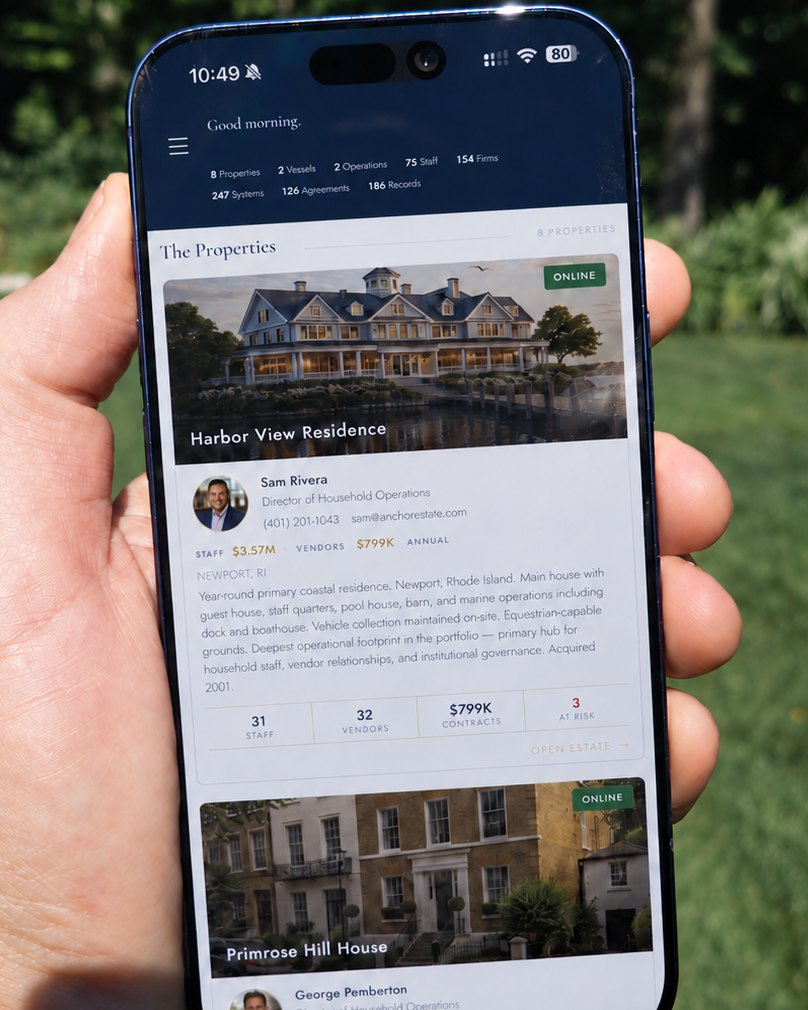
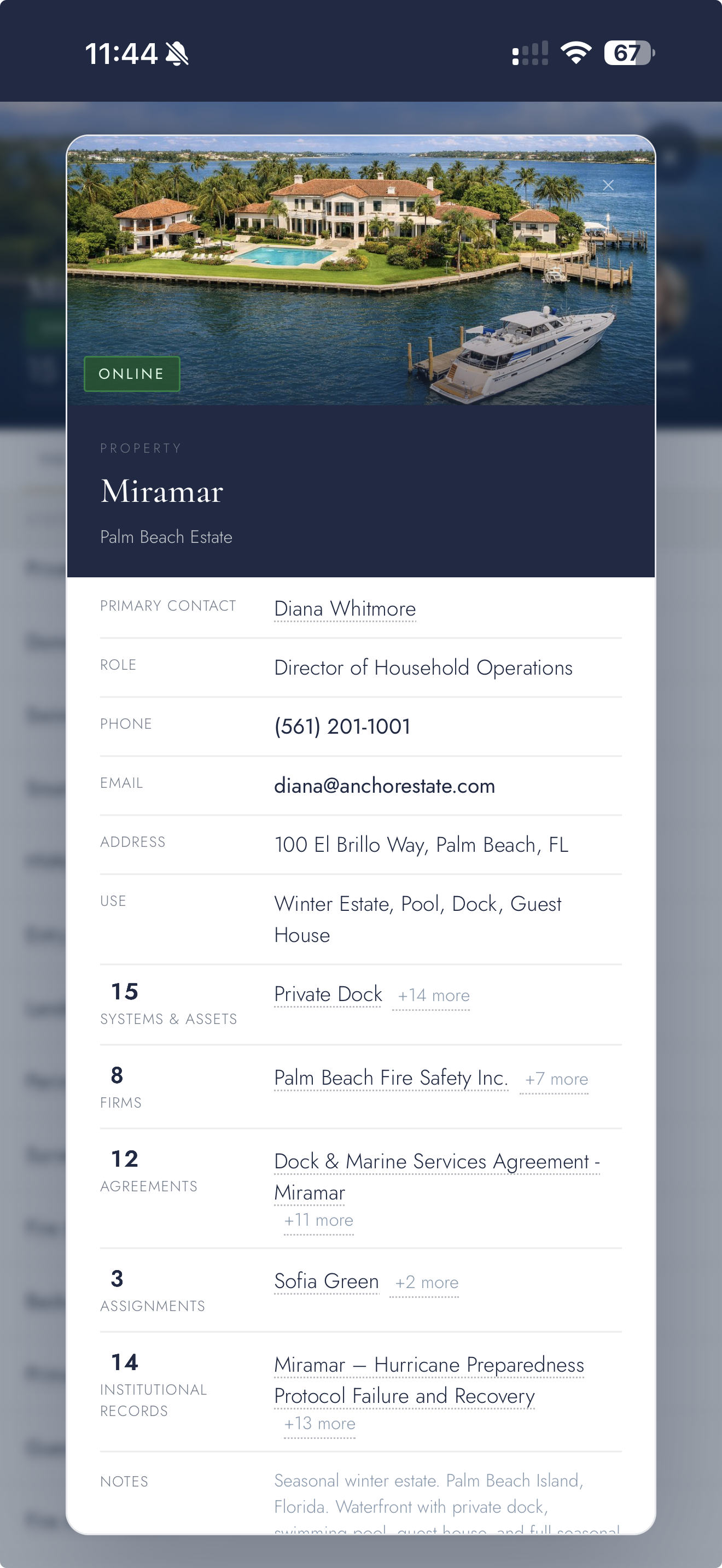
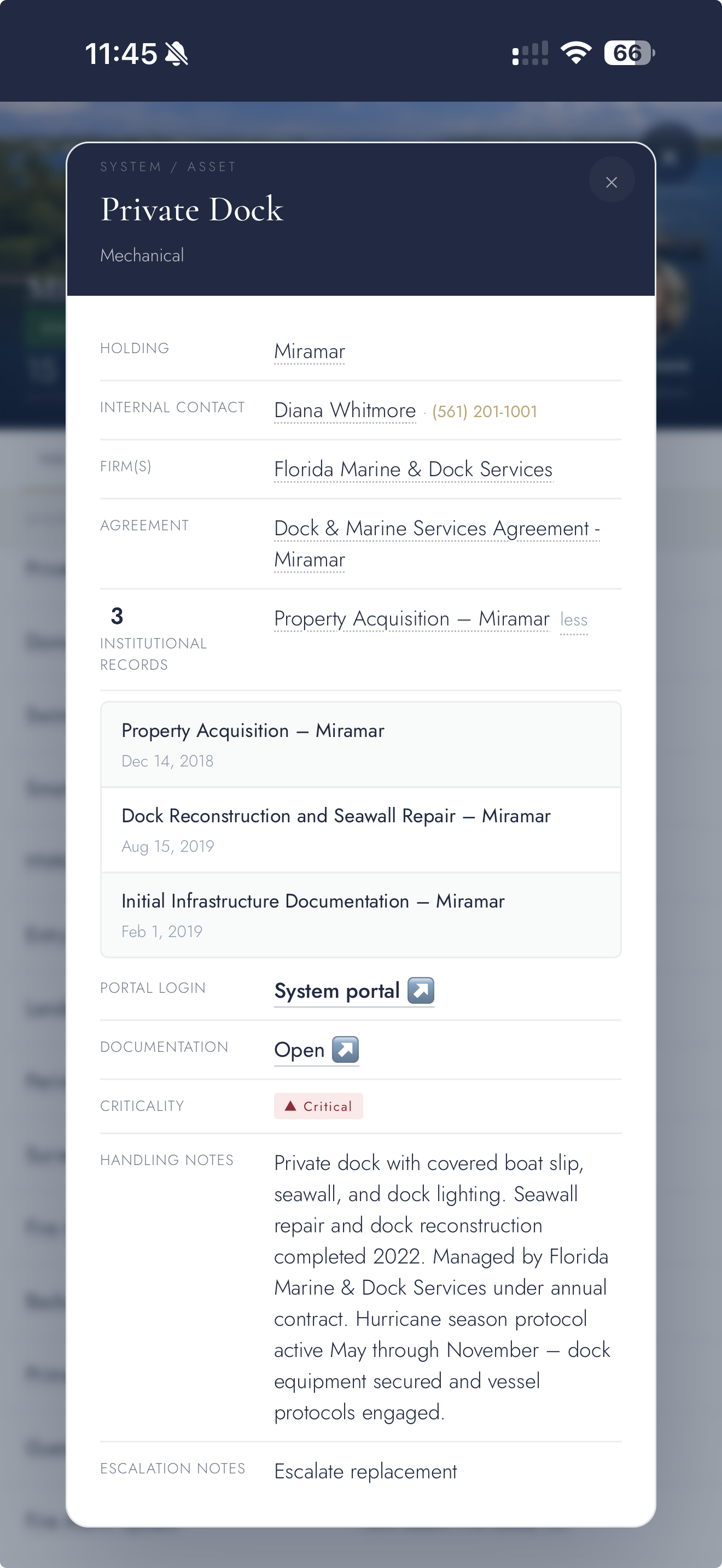
The Anchor House estate record open on a phone while standing on estate grounds.
What Changes When the Estate Owns the Record
Transition
A new operator arrives to an existing record of the estate – its firms, agreements, systems and prior decisions. They don't reconstruct it from whoever happens to remain.
Operations
Operators keep using the systems and methods that work for them. Anchor House maintains the estate-level record around that work.
Over Time
The record gets more useful with age. A decision made ten years ago stays connected to the property, system, firm and people involved in it.
The Physical Layer

The record has a body.

Every engagement leaves physical objects behind – held by the principal, and by those who run the estate. Access is credentialed by role for each estate, with each person seeing the holdings and records appropriate to their responsibility.
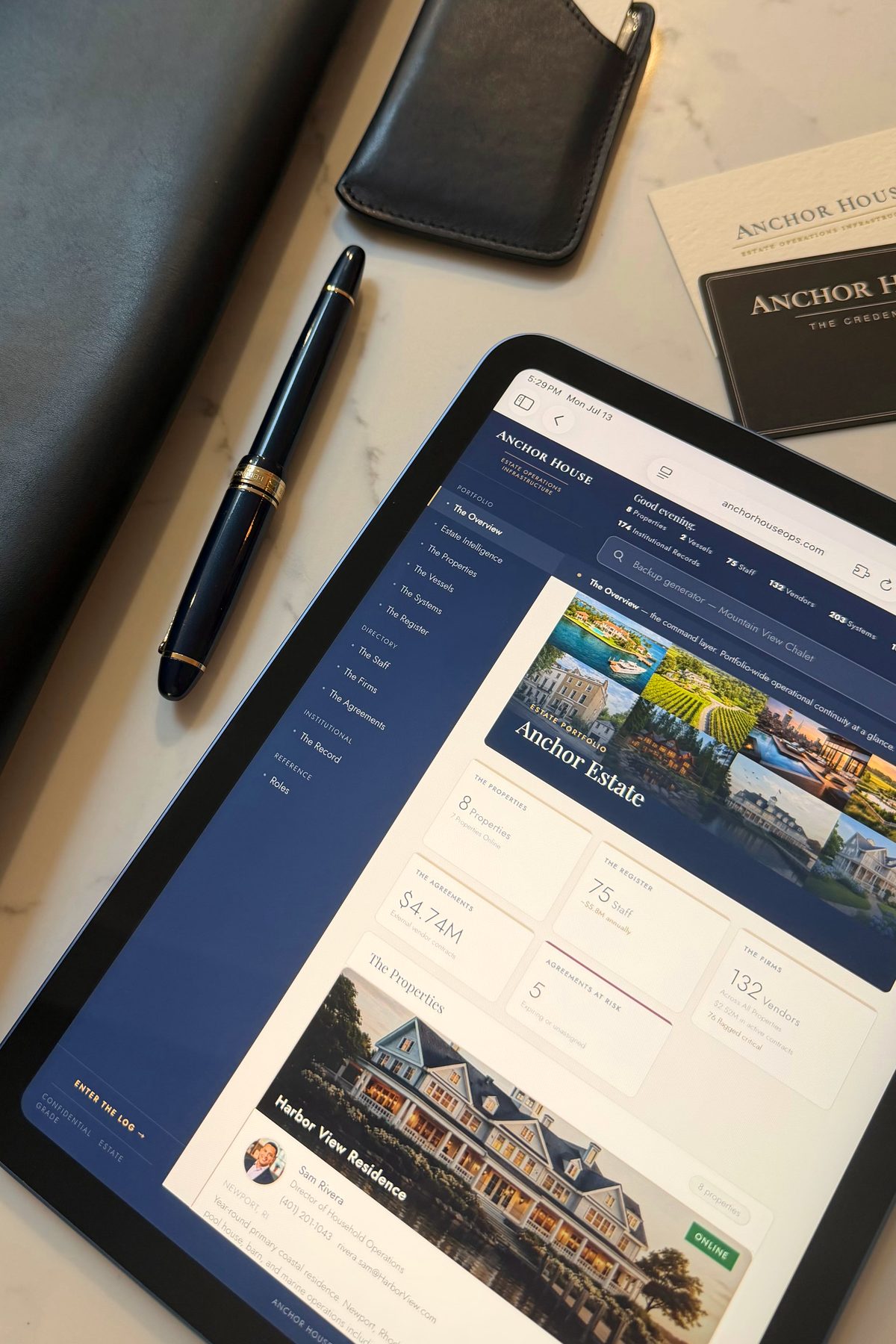
An iPad displaying the Anchor House estate record beside the physical artifacts – the leather folio, the letterpress cards, and the Credential.
The Practice

A Quiet Practice

Anchor House is a founder-led practice, supported by a technical lead and advisors, that takes on a small number of estates and maintains each record on an ongoing basis. Engagements begin with a conversation, by introduction. The record they produce is built to outlast everyone who touches it. If you operate a complex estate – or advise those who do – we'd welcome that conversation.